

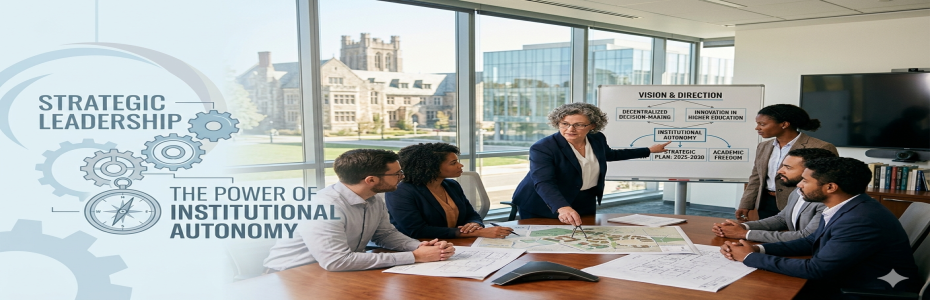
Strategic Leadership and the Power of Institutional Autonomy
- General
- Avirup Mazumdar
I. Education as a Leadership Blueprint
In the modern business landscape, choosing a management program is not simply about obtaining a qualification; it is about defining one’s leadership orientation. Management education today must prepare individuals not only to manage systems but to navigate volatility, complexity, and global interdependence. The debate between an autonomous PGDM and a university-affiliated MBA reflects two contrasting approaches to this preparation.
II. Autonomy in Action: The PGDM Approach
Autonomous institutions offering PGDM programs operate with curricular independence. This structural flexibility enables rapid integration of industry trends, technological developments, and emerging managerial frameworks.
- Key Characteristics of the PGDM Framework:
- Dynamic Curriculum Design – Courses are regularly updated to align with industry demands and global business transformations.
- Experiential Immersion – Case simulations, live projects, and corporate mentorship form the backbone of applied learning.
- Personalized Specialization – Students curate their academic journey in alignment with career aspirations and market positioning.
- Leadership Formation – Emphasis on ethical reasoning, strategic communication, and resilience under uncertainty.
III. The University-Affiliated MBA Structure
MBA programs operating under university governance typically follow a standardized academic framework. This structure ensures theoretical rigor and consistency across affiliated colleges. However, centralized approval mechanisms may limit the speed at which curriculum revisions occur. While this model preserves academic tradition, its responsiveness to market disruptions may be comparatively restrained.
IV. Institutional Ecosystem and Industry Alignment
An autonomous management institute often cultivates a close interface with industry through leadership forums, corporate cells, incubation platforms, and alumni networks. The educational environment extends beyond classrooms, positioning students as active contributors to organizational problem-solving.
- Strategic Dimensions of an Autonomous Model:
- Collaborative Leadership – Peer-driven initiatives foster accountability and team intelligence.
- Skill-Centric Development – Competence-building workshops complement academic evaluation.
- Global Competency – Exposure to international case studies and cross-cultural business contexts enhances adaptability.
V. Conclusion: Leadership Shaped by Design
Ultimately, the distinction between a PGDM and an MBA extends beyond nomenclature. It reflects the educational architecture that shapes managerial identity. An autonomous PGDM model emphasizes adaptability, strategic foresight, and proactive engagement with industry realities. For aspiring leaders who seek transformation rather than mere qualification, such a model offers an environment designed for evolution and impact.
"The future belongs to those who learn faster than the pace of change."